
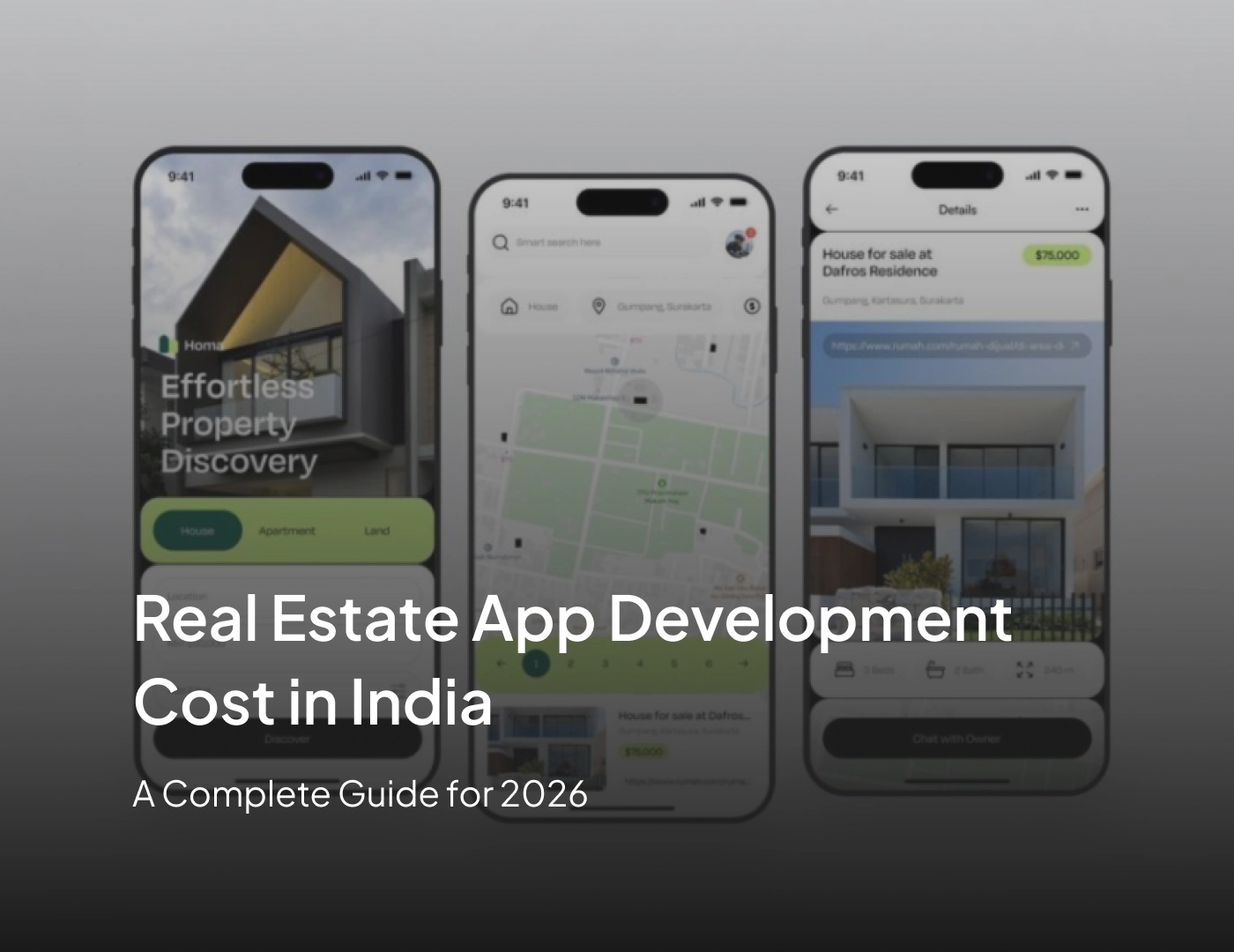
When founders start exploring digital products in the property space, one question comes up almost immediately: what is the real estate app development cost in India?
It sounds like a straightforward question, but in practice, it rarely has a simple answer. The cost of building a real estate app is not defined by a single number. It is shaped by your business model, the experience you want to create, and how you plan to scale over time.
If you are building something in this space, it helps to understand how pricing actually works before you commit resources. This guide breaks it down in a way that reflects real project experience, not generic estimates.
Why India is a preferred choice for app development
India has steadily become a strong base for product development, especially for startups and growing businesses targeting global markets. The advantage is not just cost efficiency. It is the combination of technical depth, product thinking, and the ability to build scalable systems.
For businesses evaluating the real estate app development cost in India, this often means you can build a robust product without overextending your budget in the early stages.
Understanding real estate app development cost in India
The most important thing to understand is that cost is a function of decisions. What you build and how you build it will directly influence the investment required.
Based on current industry patterns in 2026, here is how projects typically fall into broad ranges.
A basic real estate app with essential features usually sits in the range of fifteen thousand to twenty five thousand US dollars.
A mid level application with custom search, maps, and user interaction features typically ranges between twenty five thousand and fifty thousand US dollars.
More advanced platforms with multiple user roles, deep integrations, and intelligent features can go beyond seventy thousand US dollars and scale upward depending on complexity.
These are not fixed quotes. They are directional benchmarks to help you understand how real estate app development cost in India evolves as your product becomes more sophisticated.
The factors that actually drive cost
Product scope and complexity
At the core of every pricing discussion is scope. A simple listing platform is very different from a full scale property marketplace.
If your app only allows users to browse listings and contact sellers, the build is relatively straightforward. But if you are creating a system where agents manage properties, users book visits, and transactions are tracked within the platform, the complexity increases significantly.
This is often the biggest driver behind real estate app development cost in India.
Features and functionality
Features define both the user experience and the effort required to build it.
Most real estate apps start with a set of core features such as user registration, property listings, filters, and contact options. These are expected and relatively standard.
As you move beyond that, features start to shape cost more aggressively. Map based search, saved searches, notifications, and chat systems require additional layers of development.
Then there are advanced capabilities such as virtual tours, AI driven recommendations, and predictive pricing insights. These are powerful, but they require careful planning and execution.
Every feature you add increases development time, testing effort, and long term maintenance.
Platform choice
Choosing where your app will run is another key decision.
Building separate native apps for Android and iOS increases development effort. Cross platform frameworks have improved significantly and are widely used in 2026. They allow teams to build a single codebase that works across platforms, which can help optimize both cost and timeline.
Your choice here will directly influence the overall real estate app development cost.
User roles and backend systems
Real estate apps are rarely single sided. Most involve multiple user roles.
You may have buyers, sellers, agents, and administrators interacting within the same ecosystem. Each role requires its own interface and logic.
This adds backend complexity, which in turn affects development effort. Many founders underestimate this aspect when initially estimating cost.
Integrations and external systems
Modern real estate platforms connect with a range of external services. These may include map services, CRM systems, analytics tools, and sometimes payment gateways.
Each integration requires planning, development, and testing. While integrations make your product more powerful, they also contribute to the overall real estate app development cost.
How AI is influencing development in 2026
Artificial intelligence is no longer a future concept in this space. It is already shaping how apps are built and how they function.
From a development perspective, AI assisted tools help speed up repetitive tasks. This can reduce the time required for certain parts of the build, which may optimize cost to some extent.
However, AI is also raising user expectations. Features like personalized property recommendations, intelligent search, and automated assistance are becoming standard.
This creates an interesting shift. While development becomes more efficient, the baseline for what users expect continues to rise. As a result, the real estate app development cost is not necessarily decreasing, but evolving.
The role of cloud and scalable architecture
Another important factor in 2026 is the shift toward cloud native development.
Instead of building heavy systems upfront, many teams design apps that scale gradually. This approach allows businesses to start lean and expand infrastructure as user demand grows.
From a cost perspective, this means part of your investment moves from initial development into ongoing operations. It creates more flexibility and reduces the risk of overbuilding early on.
Timeline and its impact on cost
Time and cost are closely connected.
A basic version of a real estate app may take around three to four months to build. A more feature rich product can take six months or more, depending on complexity.
If you try to compress timelines, you often need a larger team. This increases cost. On the other hand, a more phased approach can help manage both timeline and budget more effectively.
Costs beyond development
One of the most common mistakes founders make is focusing only on the build phase.
In reality, your app will continue to evolve after launch. You will need to plan for maintenance, updates, performance improvements, and security.
There are also infrastructure costs, especially if your app starts scaling. These ongoing investments are part of the real estate app development cost in India, even though they are not always visible at the start.
A more practical way to approach budgeting
Instead of trying to define the total cost upfront, it is often more effective to think in stages.
Start with a focused version of your product. Identify the core problem you are solving and build only what is necessary to validate it.
Once you have real users and feedback, you can expand with more confidence. This approach not only controls cost but also reduces the risk of building features that are not actually needed.
Final thoughts
The real estate app development cost in India is not just a number. It is a reflection of your product vision, your priorities, and the decisions you make along the way.
In 2026, the tools available to build digital products are more powerful than ever. But success still depends on clarity and discipline. Building everything at once is rarely the right approach.
The businesses that succeed in this space are the ones that focus on creating meaningful user experiences, invest thoughtfully, and evolve their products over time.
If you approach development with that mindset, India offers one of the most balanced environments to build a real estate platform that is both scalable and sustainable.
And if you are looking for a team that thinks beyond just development and focuses on building the right product, that is where a partner like Haatch Interactive naturally fits into the journey.